Inclusively Excluded
the white elephant in the room

Over two years ago, I wrote about financial inclusion in the context of remittances. And then a year ago, I speculated on the possibility of how people in the Global South are “resisting” financial inclusion.
Now that the World Bank has a new version of their financial inclusion database, it is time to revisit the beast and draw new charts. Here is the first one:
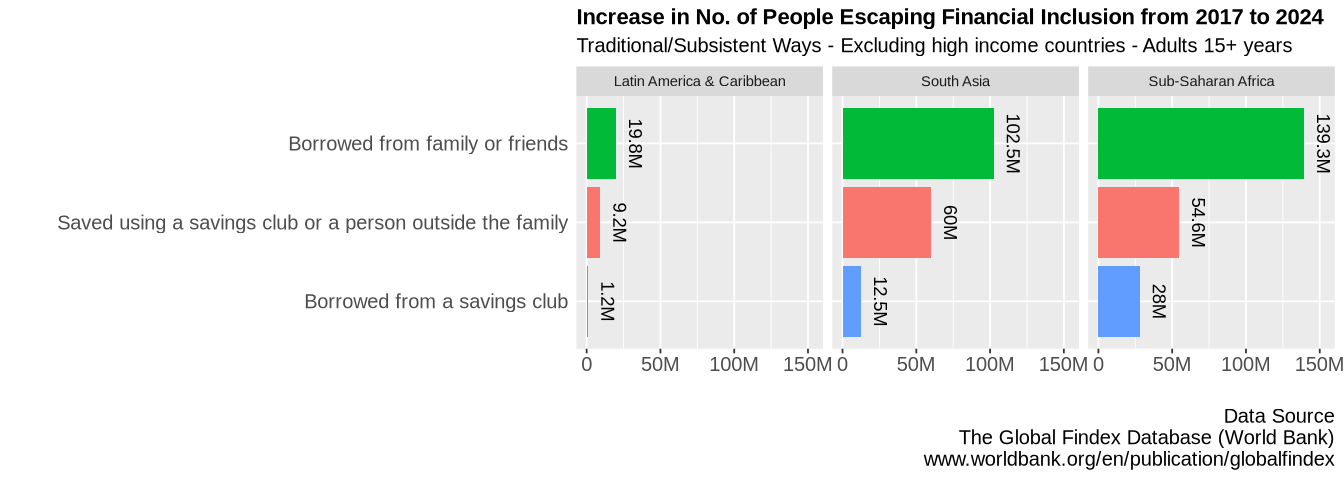
Sub-Saharan Africa once again leads the way in using traditional/subsistent ways to borrow and save to get by.
The numbers on the green bars can be interpreted as follows: they represent the increase in the number of people escaping financial inclusion - using borrowings from family or friends - from 2017 to 2024 .
So 139 million more people relied on traditional ways of borrowing from family or friends in Sub-Saharan Africa in 2024 than they did in 2017 (and as a consequence, avoided borrowing from financial institutions, the endgame of the ensnarement.)
I explain why I chose 2017 as the reference year (and why those three specific regions) in the About section of an interactive visualization that I made here.
So once again, we have more people in Sub-Saharan Africa evading financial inclusion than any region in the world (despite South Asia’s larger population).
Now if we take the top countries from each of these three regions and compare them, not just in absolute numbers, but in percentages, we get something interesting:
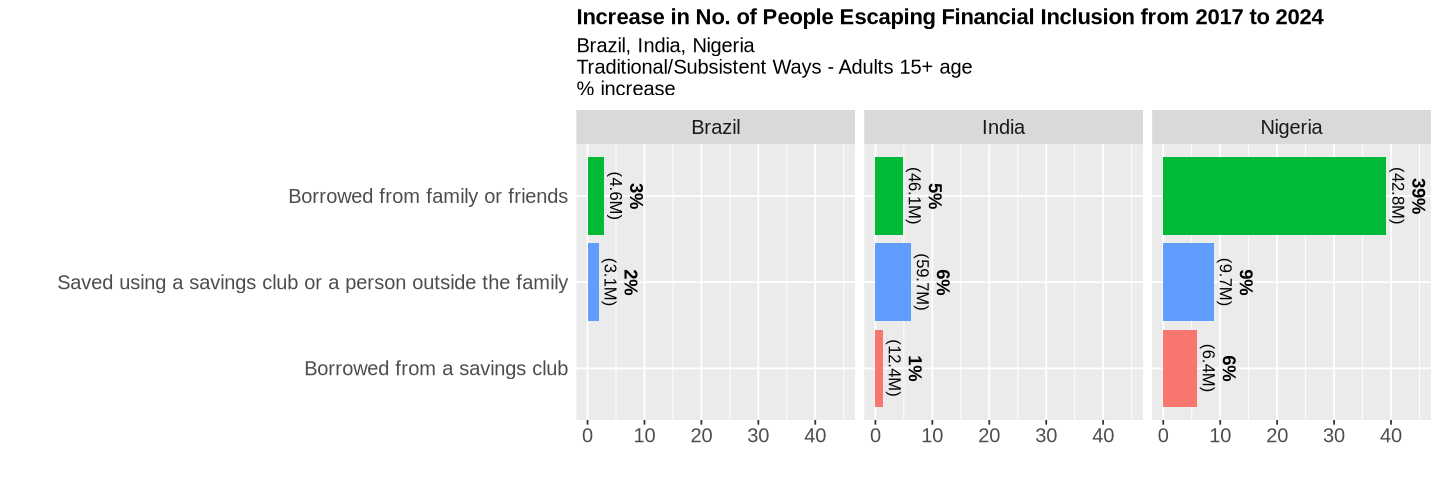
The increase in Nigeria’s ‘borrowing from family or friends’ in percentage terms is a whopping 39%. So we ask, “what might explain this?”
The common refrain is to explain it away in terms of Nigeria being conflict ridden which could scare formal financial institutions away. But ACLED’s conflict index ranks Brazil right after Nigeria (5 and 6 in their ranking of 50 countries; India is ranked at 15). So the knee-jerk explanation doesn’t go very far.
Now I bring in a graph to introduce a tangential cultural factor:
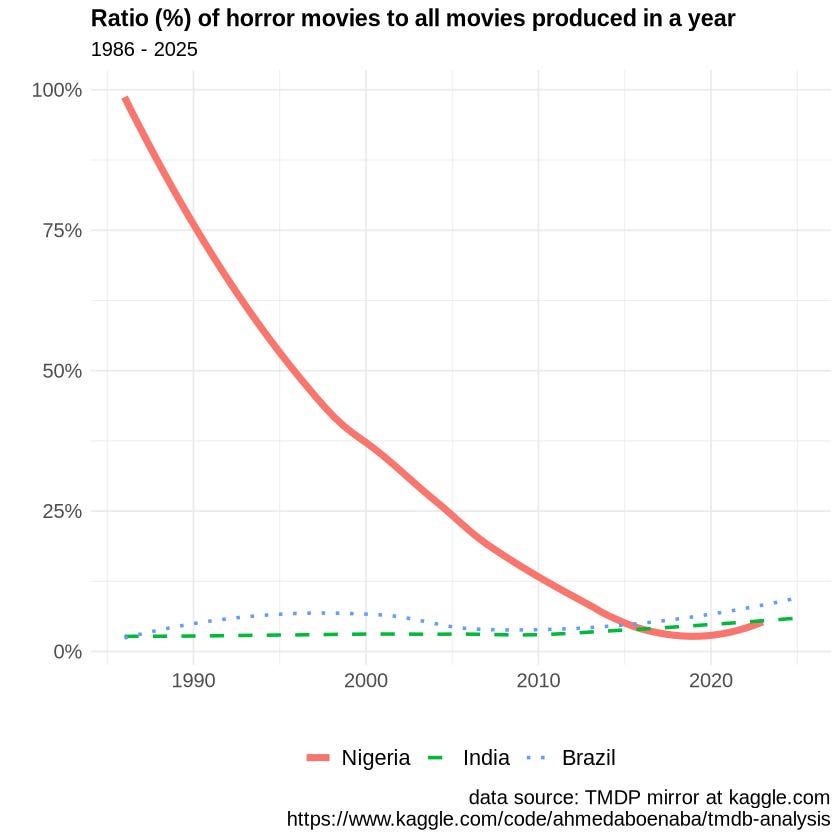
The chart pretty much speaks for itself (we start with 1986 because that’s the first year of data for Nigerian movies in the database).
And if the optimism of the imagination has not raced ahead of the pessimistic intellect as yet, here’s an African filmmaker, Ousmane Sembène, on the sun and the sunflower.
Tying this to financial inclusion, the elephant in the room is a supremacist notion of what’s good for the Other.
The elephant in the room is white…
And about time we let it know it is not wearing any clothes.