
The Residual Many
Hope in the Peripheries
The Residual class - working age people who are either informally employed or officially not part of the ‘labor force’ - are about three quarters of the working age population worldwide.
This Residual class can be looked upon as Shelley’s many (against the few), or more poignantly, Fanon’s wretched of the earth (against the Epstein class).
Here’s connecting the dots:
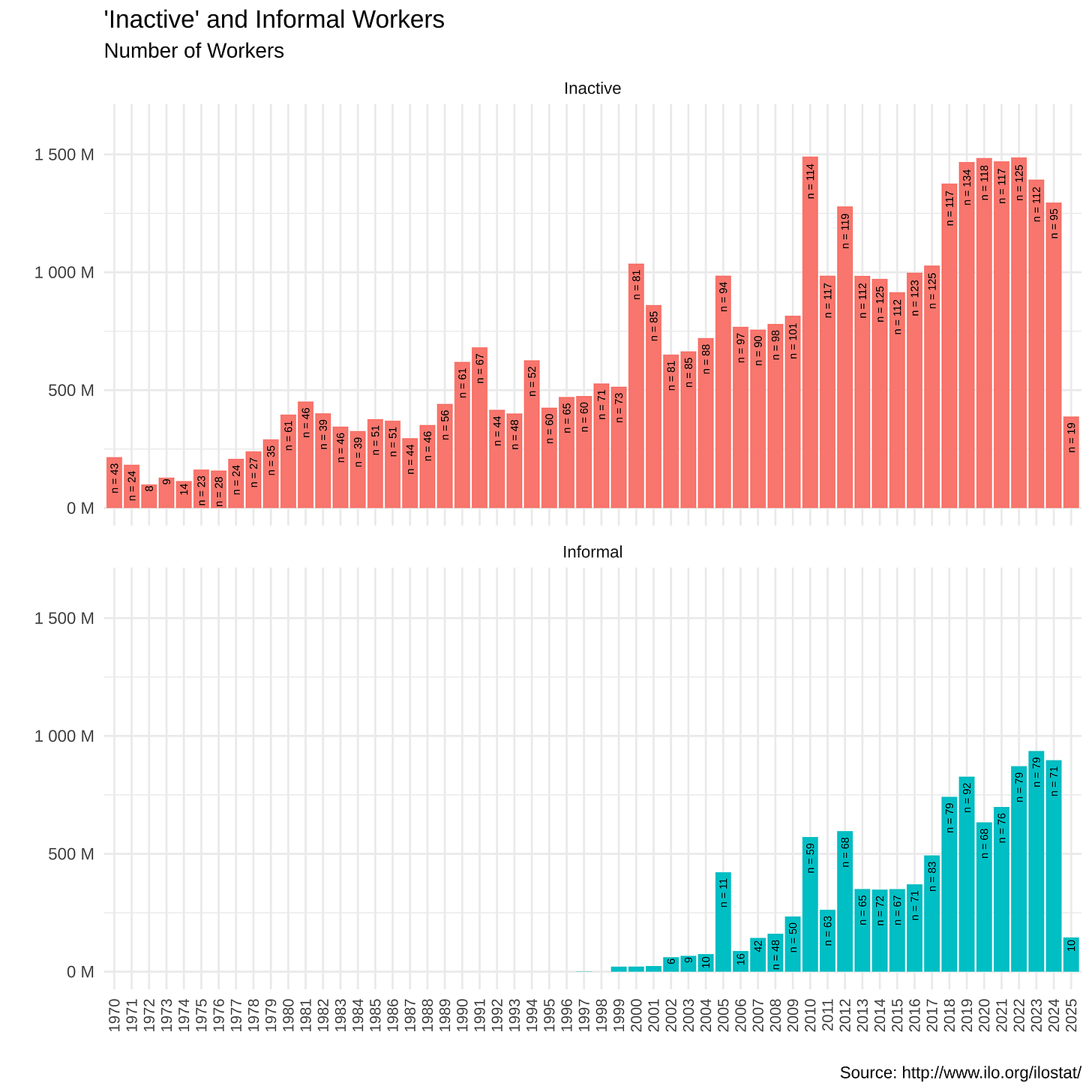
When we put inactive1 and informal2 workers together on a chart, nothing really jumps out except that the figures look quite high - especially for inactive workers3.
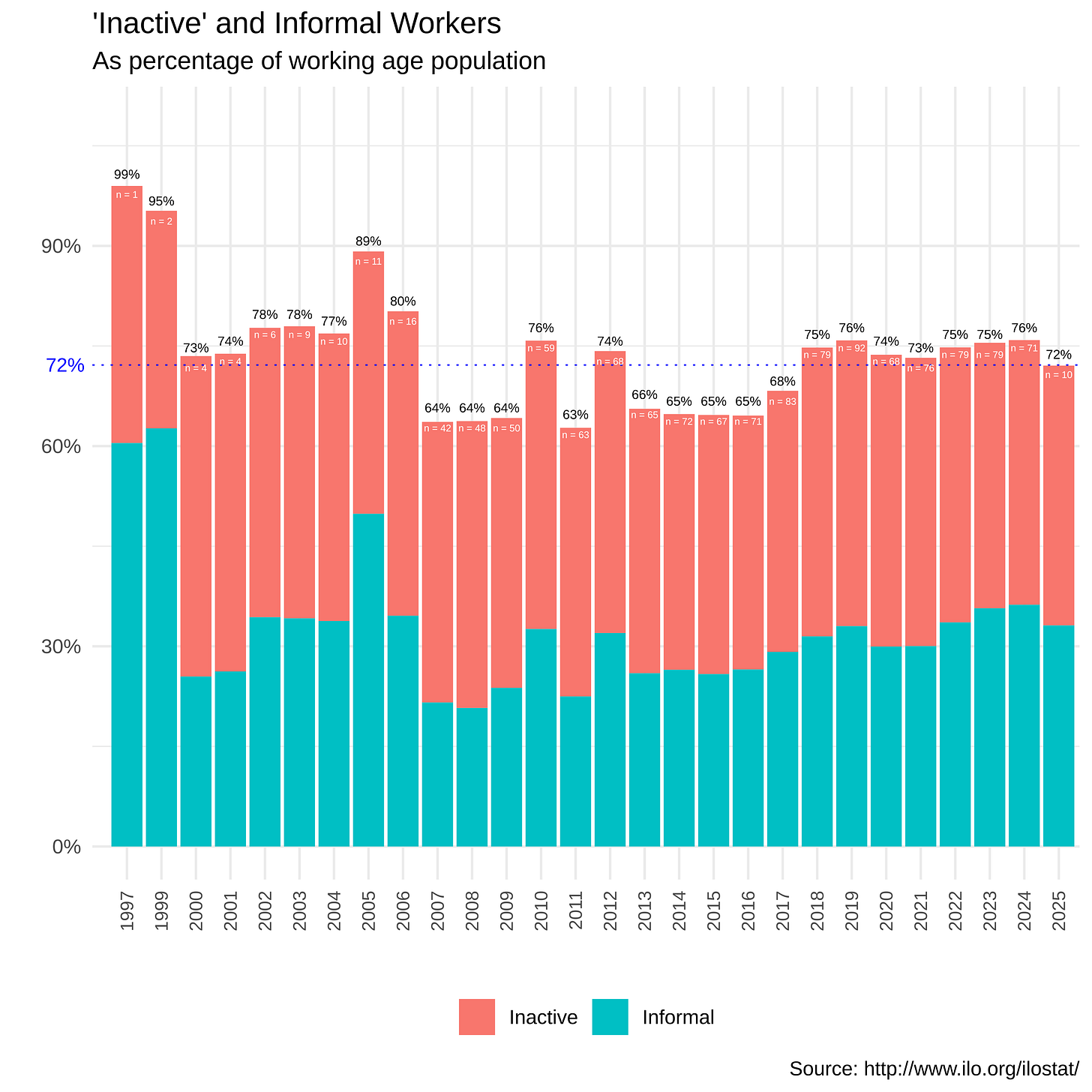
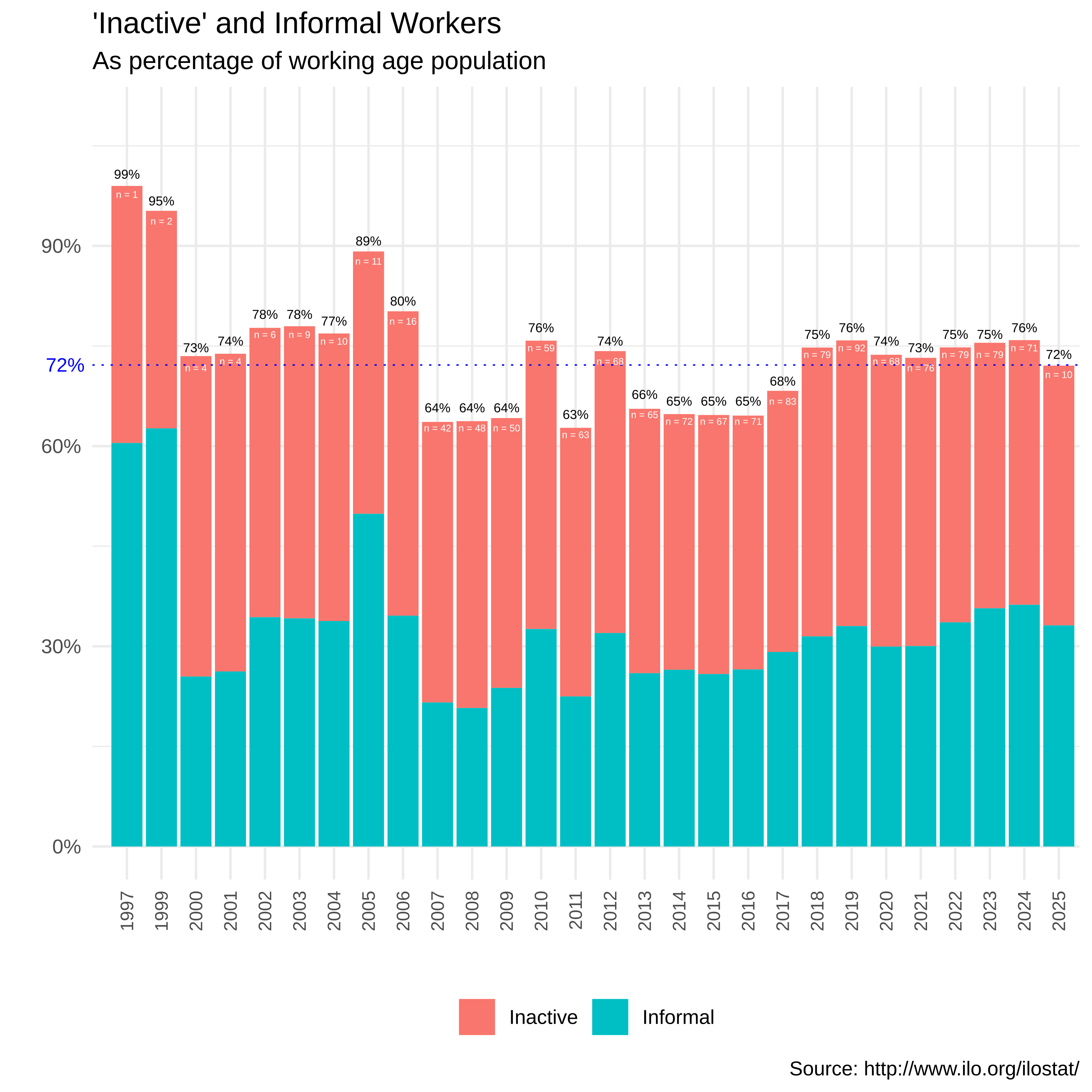
But… when we add things up carefully, we see that on average, 72% of the working age people are Residual4.
The informal worker is enmeshed in the circuits of capital but only as an appendage - in the peripheries or as second class citizens. The priests of capital are constantly debating: whether to grant them full citizenship or to further marginalize?
The inactive are not carefree non-workers but care workers, constantly sustaining life while shirking the priestly gaze that covets their inclusion as much as it gloats over their exclusion.
The immiseration of the Residuals serves to bolster one aspect of Wetiko - namely capital - while serving as the other for another aspect of the disease - namely colonialism. The unspeakable horror of the wars of today is yet another manifestation of the same pathology of the powerful - this time under the guise of imperialism - that revels in the extermination of the marginalized.
What I have attempted here is to view the wretched, the many, and the underclass through the obfuscations of official statistics. A subtler take on a not-so-subtle evil.
From the viewpoint of the mandarins of capital, the number of Residuals is cause for disingenuous pity.
From the viewpoint of the masses, it is hope.
How Epstein’s nobodies can be the revolutionary’s hope, that is for another time.
Inactive workers are defined by the ILO (International Labor Organization) as those of working age but not officially part of the ‘labor force’. Since they are not part of the labor force, they are technically not ‘unemployed’.
Informal workers are employed outside of ‘formal’ arrangements, i.e., no contracts and no benefits: where the laws of whichever land that they might belong to can be excused if they look the other way.
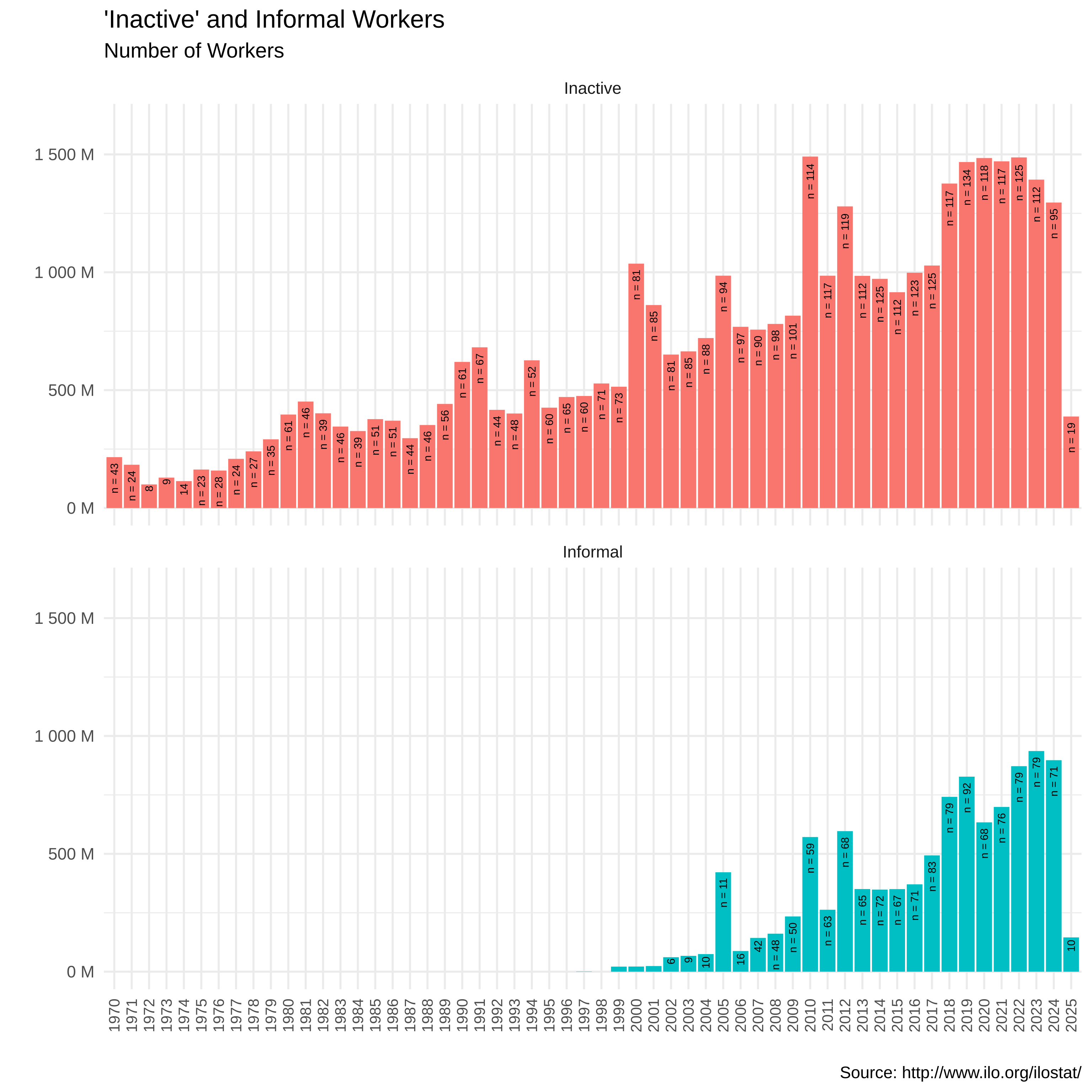
These are the numbers of inactive and informal workers for each year worldwide. And these numbers depend on the number of countries - noted in the bars - which reported these figures. So for example, “n = 10” means 10 countries reported the figures. And we can see that the number of countries reporting figures for informal workers is less than those reporting inactive workers. Not only that, from 1970 to 1996, there is no reporting of informal workers.
The idea is to add up both informal and inactive workers and divide the sum by the number of working age people. For this, we include only those countries - for each year - where both informal and inactive numbers are reported. This automatically excludes the earlier years - from 1970 to 1996 - where there was no reporting of informal workers.